
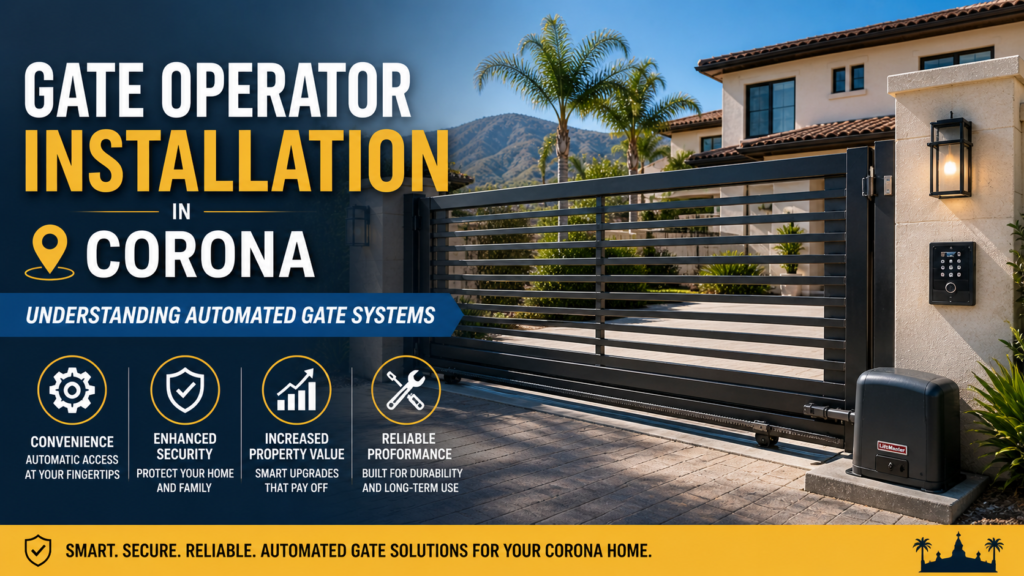
An automated gate is only as reliable as its operator. The Gate Operator Installation Corona sometimes called a gate opener or gate motor, is the mechanical and electrical heart of any automatic gate system. For homeowners and business owners in Corona, California, understanding how gate operators work, what types are available, and what the installation process involves is essential for making the right choice for their property.
What Is a Gate Operator?
A gate operator is a motorised device that automates the opening and closing of a gate. It replaces the need for manual effort and allows the gate to be controlled remotely via key fobs, keypads, intercoms, vehicle-mounted transmitters, or smartphone applications. At its core, a gate operator consists of a motor, a drive mechanism, a control board, and a power source. Together, these components detect when a signal to open or close has been received and then convert electrical energy into the mechanical motion that moves the gate.
Gate operators are rated by class, ranging from Class I for residential use to Class IV for industrial or high-security applications. Most residential installations in Corona fall into the Class I or Class II category, which covers lighter gates with moderate cycle frequencies.
Types of Gate Operators
The type of operator required depends primarily on the gate’s design and how it moves.
- Swing Gate Operators: Used for gates that open in an arc, like a door. These come in three primary varieties. Ground-mounted operators are the most common, sitting on a concrete pad next to the gate hinge post. Actuator-style operators (also called articulating arm or telescoping arm operators) mount directly to the gate itself and require less side clearance. Subterranean operators are installed underground for a completely concealed appearance.
- Sliding Gate Operators: Used for gates that travel horizontally along a track. The two main drive types are chain drive and rack-and-pinion. Chain-drive operators connect to the gate via a visible drive chain. Rack-and-pinion systems use a toothed rack mounted to the gate and a pinion gear in the operator for a more compact arrangement.
- Solar-Powered Operators: Available for both swing and sliding configurations, these operators are powered by a solar panel connected to a battery backup. They are well-suited for locations in Corona where running electrical conduit to the gate would be costly or impractical. Given the region’s sunny climate, solar operators can be an efficient and reliable option.
- Hydraulic Operators: Used in commercial or high-traffic environments, hydraulic operators use fluid pressure to generate movement. They are extremely durable and can handle heavy gates and high cycle volumes, making them common for gated community entrances and industrial facilities.
Choosing the Right Operator
Matching the operator to the gate is one of the most important steps in any installation. Several factors guide this decision.
Gate weight and length are primary considerations. Heavier gates demand more powerful motors. A residential ornamental iron gate weighing a few hundred pounds has very different requirements than a heavy commercial steel gate. Running an underpowered operator on a heavy gate accelerates mechanical wear and leads to premature failure.
Daily cycle count also matters. A residential gate that opens and closes a handful of times per day can be served by a light-duty residential operator. A gated community entry point or a commercial property with frequent traffic flow requires a heavy-duty operator rated for hundreds of cycles per day.
Power source availability determines whether a hardwired or solar-powered unit is more practical. Most operators require a standard 120V or 24V DC electrical supply, which means a power line must be run to the installation point.
Compatibility with desired access control features such as intercoms, video systems, keypads, or smart home integration also influences which operator is selected. Not all operators support all access control configurations, so the intended access method should be confirmed before purchase.
Safety Features
Gate operators installed in California must comply with UL 325, the safety standard for gate operators established by Underwriters Laboratories. This standard mandates specific protective devices to prevent the gate from causing injury or property damage.
Photoelectric sensors (photo eyes) detect objects in the gate’s path and reverse the gate’s direction to prevent entrapment. Reversing in-ground loop detectors sense vehicles in the path of a closing gate and halt operation. Edge sensors on the gate panel detect contact with an obstruction and trigger an auto-reverse. Emergency access key switches allow the gate to be opened manually by fire or emergency services personnel.
Proper safety device installation is not optional it is a legal requirement for residential and commercial gate systems in California.
The Installation Process
Installing a gate operator begins with a site assessment to confirm that the gate and its support structure are in good condition and properly aligned. Gates that drag, lean, or hang unevenly must be corrected before an operator is installed, as the motor is not designed to compensate for structural deficiencies.
The operator unit is then mounted either on a concrete pad beside the gate, on the gate structure itself (for actuator-style units), or in a suitable housing for concealed installations. Electrical connections are made, with wiring run in conduit from the power source to the operator. The control board is programmed, access control devices are wired and configured, and safety sensors are positioned and tested. The final step involves conducting a full operational test, confirming that open and close commands work correctly, that the auto-reverse function engages as intended, and that manual release (for power outages) is accessible and functional.
Maintenance of Gate Operators
Like all mechanical systems, gate operators benefit from regular inspection and maintenance. Lubricating moving parts, checking all electrical connections, testing safety sensors, and verifying that the control board is responding properly are all part of routine upkeep. For solar-powered systems, the solar panel and battery should be inspected to ensure they are holding and delivering adequate charge. Most professional installers recommend a service check at least once per year for residential systems and more frequently for high-cycle commercial installations.
Conclusion
A gate operator brings convenience, security, and functionality to any driveway gate system. Understanding the types of operators available, the factors that determine the right choice, and the standards that govern safe installation empowers property owners in Corona to approach automated gate projects with confidence. A correctly matched and professionally installed operator delivers years of reliable performance and turns a manual gate into a seamless, modern access control system.